How many solar panels do I need?
The honest answer depends on three numbers: how much electricity you use in a year, how much sun your roof gets, and how much power each panel makes. Work through the steps below with your own bills and you will have a panel count you can trust before any installer visits.
Start with your bills, not a rule of thumb
Rule of thumb figures like 20 panels for an average home are a poor place to start, because two homes of the same size can use very different amounts of electricity. Heating, cooling, a pool pump, or an electric vehicle can each move the answer by several panels. The only solid starting point is your own usage, and it is printed on your electricity bill.
Add up the kWh figure from 12 months of bills. Twelve months matters because usage swings with the seasons: air conditioning in summer and heating in winter can each double a mild month. If you have moved recently or you have lost some bills, most utilities show 12 months of history in their online account or app. The system size tool that works from monthly kWh runs the same first step for you if you would rather enter one number and see the result.
Turn annual use into a daily figure
Divide your annual total by 365. That gives the average kWh your home uses each day, which is the figure the rest of the maths needs. An installer will ask for this number first, so it is worth knowing before you request quotes.
Divide by peak sun hours
Peak sun hours measure how many hours of full strength sunlight your location gets on an average day. They are not the same as daylight hours. A cloudy northern town can have 15 hours of daylight in June but only 3.5 peak sun hours, while a desert city gets fewer daylight hours and far more intensity through them. This is the single biggest factor that separates a 15 panel system from a 25 panel system for the same usage.
Divide your daily kWh by your peak sun hours and the result is the system size in kW. The PVWatts tool from the National Laboratory of the Rockies gives an exact peak sun hours figure for your address, and it is free to use.
Add losses, then divide by panel wattage
A system never delivers its full rated output. The inverter loses a little, panels lose output as they heat up, and wiring, dust, and shading take more. Add about 15 to 20 percent to the kW figure to cover these losses, which means dividing by 0.8 to 0.85 instead of 1, or multiplying by 1.15 to 1.20.
Now divide the adjusted system size in watts by the wattage of the panel you plan to use, and round up. Most residential panels sold today are 350 to 440 watts, and higher wattage panels need fewer of them for the same output, which matters most when roof space is tight. The solar panel calculator runs this whole sequence from your monthly usage, panel wattage, and peak sun hours if you want to check your own arithmetic.
Worked example
Here is the method applied to one home. Treat this as an example only, not a quote. Your numbers will differ.
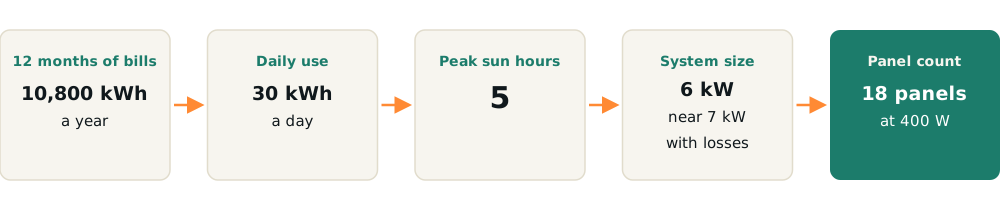
A home uses 900 kWh a month. That is 10,800 kWh a year, or about 30 kWh a day. In a location with 5 peak sun hours a day, 30 divided by 5 gives 6 kW before losses. Add about 15 to 20 percent for losses and the system is near 7 kW. A 7 kW system is about 18 panels at 400 W, or about 23 panels at 300 W.
Run your own numbers in the free system size tool that works from monthly kWh.
Roof space is often the real limit
A standard residential panel covers about 18 square feet, so 18 panels need roughly 320 square feet of usable roof, plus space around the edges for access and fire setbacks. Roof shape, chimneys, vents, and shading cut into that figure, and a roof that faces north in the northern hemisphere produces far less than one facing south. Measure the clear area before you fall in love with a panel count.
If the roof cannot fit the count, you still have options. Higher wattage panels squeeze more power from the same area, a ground mount works where the yard allows it, and a smaller system that covers part of your usage is still worth having.
Before you get quotes
Check which incentive programs apply to a system of this size in your state or province before you request quotes, since a tax credit or rebate changes the payback maths. The DSIRE database lists programs by state and is kept current by NC State with funding from the US Department of Energy.
Then take your panel count and system size to two or three local installers and ask each one to confirm the figure after a site visit. A licensed installer checks shading, roof condition, your electrical panel, and local permitting, and their final design is the one that gets built. The numbers in this guide are planning estimates, there to help you spot a quote that is far too big or far too small, not to replace the visit.
Try the free solar panel calculator
Enter your monthly usage, panel wattage, and peak sun hours, and check your own panel count.
Open the solar panel calculatorLast updated: 15 November 2026.
Questions
Frequently asked
A typical home lands between 15 and 25 panels, but the spread is wide. The count follows your annual electricity use, panel wattage, and peak sun hours, so two homes with the same roof can need very different counts. Working from your own bills is the only way to get a number that fits your home.
Peak sun hours count how many hours of full strength sunlight your location gets in a day, not how many hours it is light outside. Sunny southern states average around 6 to 6.5, while cloudier northern areas average closer to 3.5 to 4. The free PVWatts tool gives an exact figure for your address.
Yes. A 400 watt panel makes about a third more power than a 300 watt panel of a similar size, so a system built with higher wattage panels needs fewer of them to reach the same total output. That matters most when roof space is tight.
If you plan to add an electric vehicle or a heat pump in the next few years, it is usually cheaper to size slightly larger now than to add a second array later. Add 20 to 30 percent to your current usage figure if a major electric appliance is on the horizon.