What size battery do I need for overnight backup?
A battery that is too small leaves you in the dark before morning. One that is too big costs more than it needs to. The right size comes from one step: work out what you actually need to keep running overnight, then size the battery to that number.
Start with the loads, not the battery
Most people start by asking how big a battery they should buy. That is the wrong first question. A battery is sized by the loads it must carry, so the work starts in your own home, not in a product catalogue. Walk through the house in the evening and write down everything that must stay on through the night.
For each load, note its power draw in watts and how many hours it runs overnight. Multiply the watts by the hours to get watt-hours, add the results together, and divide by 1,000 to get kilowatt-hours. That total is your usable energy target: the amount of energy the battery must actually deliver before morning.
This number is personal. A household that runs a fridge and a few lights needs far less than one that also runs a freezer, a fan, and a medical device all night. Two homes the same size can need very different batteries, which is why a rule of thumb based on house size is a poor way to choose. A battery storage size calculator can run the same steps from your own load list and turn it into a size to shop with.
A worked example
Take a simple overnight list as an example only, not a quote. A fridge, lights, wifi, and a few chargers running through the night might come to about 5 kWh of usable energy. That figure is the usable energy target for this example household, and it is the number the battery must deliver, not the number printed on the battery box.
Your own list will give a different number, and that is the point. Add a freezer, a fan, or a medical device, and the total climbs. Leave the lights off and charge the phones before bed, and it falls. Run the maths on your own loads before you look at any battery.
If the number comes out higher than you expected, look at the list again before you look at bigger batteries. Moving a load out of the overnight hours, like running the dishwasher before bed instead of on a timer at 2 a.m., or turning off lights you do not need, cuts the target directly. Every load you remove from the overnight list is energy the battery no longer has to store.
Usable capacity is not nameplate capacity
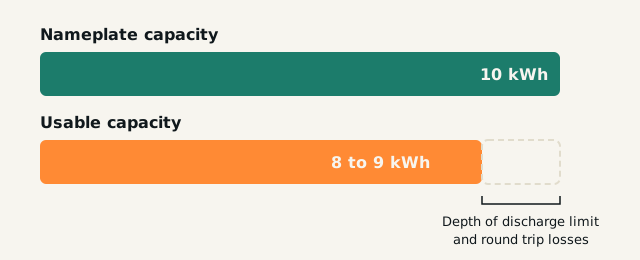
A battery's nameplate capacity is the total energy it can store. Its usable capacity is the energy you can actually draw from it, and the two are never the same. Every battery holds some energy back to protect itself, which is called the depth of discharge limit, and some energy is lost as heat when the battery charges and discharges, which is called round trip loss.
That means a battery rated at 10 kWh might only deliver 8 or 9 kWh of usable energy. Size the nameplate capacity above your usable target, and check the usable capacity printed on the spec sheet rather than the headline number. If you need 5 kWh of usable energy overnight, the battery you buy should be rated well above 5 kWh.
Run your own load list in the free battery storage size calculator.
Capacity also falls over the life of a battery. A battery that covers your overnight target in its first year will deliver less in its later years as the cells age. Ask the installer how much usable capacity the battery is expected to keep after several years of use, and size with that in mind rather than the first-year figure alone.
What about whole home backup?
If you want the whole house to keep running through the night, run the same maths for every load, not just the critical ones. Add the air conditioner, the water heater, the oven, and anything else that might run, and expect a much larger number than a critical-loads battery. A whole home backup sizing calculator can run the full list and show how large that number gets.
Whole home backup also asks more of the battery in a different way. It is not only about total energy. The battery must also deliver enough power at once to start large appliances, and that power rating matters as much as the capacity. This is one of the reasons the final design belongs to a licensed installer who has seen your panel and your wiring.
Check incentives and local rules before you buy
Incentive programs for batteries change often and vary by state and province, so check what applies where you live before you buy. The DSIRE database lists incentive programs by state across the US, and it is the fastest way to see what is current.
For background on how solar and storage work together, the National Laboratory of the Rockies publishes research and homeowner resources on solar systems and battery storage.
A battery sized from your own overnight loads is the right starting point. A licensed installer confirms the final size after checking your electrical panel, your wiring, and your local rules. The numbers on this page are planning estimates, not a design for an installation.
Last updated: 15 November 2026.
Try the free whole home backup sizing calculator
Run the full load list and see how large a whole home backup battery gets.
Open the whole home backup calculatorQuestions
Frequently asked
It depends on the loads you keep running. Add up the watt-hours of each critical load for the hours it runs overnight, then divide by 1,000 to get kWh. A fridge, lights, wifi, and a few chargers might come to about 5 kWh of usable energy. Your number will be different if your load list is different.
Nameplate capacity is the total energy a battery can store. Usable capacity is the energy you can actually draw from it. The battery holds some energy back to protect itself, and some energy is lost as heat during charging and discharging. Always size from the usable capacity on the spec sheet, not the headline number.
Yes, if it is large enough. Run the same maths for every load in the house, not just the critical ones, and expect a much larger number than a critical-loads-only battery. Whole home backup also needs enough power output to handle large appliances starting up, so have a licensed installer check the design.
No. A battery can charge from the grid, and many homeowners charge overnight on a cheaper rate and use the stored energy later. Solar panels help because they can recharge the battery during the day, but the battery works without them. A licensed installer can advise on the best charging setup for your home.