How long do solar panels take to pay for themselves?
Payback is one division: the net cost of the system divided by the money it saves you each year. Work through the steps below with your own quotes and bills and you will have a payback figure you can trust before any installer visits.

In short: payback is net cost divided by yearly saving. In the worked example below, a 7 kW system costing 17,200 dollars after a rebate and saving 1,600 dollars a year pays back in about 11 years.
Payback is one division
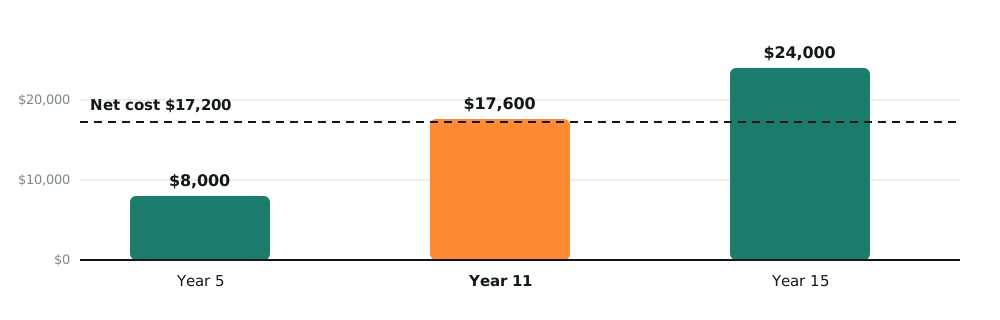
The payback period is the time it takes for the money a solar system saves you to add up to what the system cost. It is one division: net cost divided by annual saving. If a system costs 17,200 dollars after incentives and saves 1,600 dollars a year, the payback is 17,200 divided by 1,600, or about 11 years.
That simplicity is also the trap. A quote that leaves out an electrical panel upgrade, or a savings figure that assumes you use every kWh the panels make, gives a payback that looks better than the real one.
Step 1: work out the true net cost
Start with the full installed price from the quote, not the price per watt alone. That means panels, inverter, racking, wiring, labour, permits, and any electrical panel work the installer lists. Ask for the total installed price in writing, and check whether anything is listed as an extra.
The big change in 2026 is the federal credit. The 30 percent Residential Clean Energy Credit for homeowner-owned systems ended for systems placed in service after December 31, 2025, when the One Big Beautiful Bill Act was signed in July 2025. A system finished in 2025 can still claim it on the 2025 tax return, but a system bought in 2026 gets no federal credit. State and utility rebates were not touched, so check what your state and utility offer.
The result is the net cost: installed price minus incentives. That is the top number in the division. In the worked example below, the gross price is 18,200 dollars and a 1,000 dollar state rebate brings the net cost to 17,200 dollars.
Step 2: work out the real annual saving
The saving is the electricity bill you no longer pay, plus any money you earn for surplus power. Start from your annual bill, not your monthly one. Then work out how much of that bill the system covers. A system that makes 80 percent of your annual usage saves roughly 80 percent of your bill, before export rates.
The export rate matters. Power you use at home saves you the full retail rate. Power you send to the grid is paid at the export or net metering rate, which is often lower, so a system that exports a lot saves less per kWh than one sized to your own use. The first-year savings calculator runs this step from your own bill and rate.
Worked example
Here is the method applied to one home. Treat this as an example only, not a quote. Your numbers will differ.
A 7 kW system at an example price of 2.60 dollars per watt costs 18,200 dollars installed. A 1,000 dollar state rebate, used here as an example, brings the net cost to 17,200 dollars. The home's annual electricity bill is about 2,100 dollars, and the system covers enough of it to save about 1,600 dollars a year. Divide 17,200 by 1,600 and the payback is 10.75 years, or about 11 years. Run the same numbers for your own home in the free payback period calculator.
| Item | Example number |
|---|---|
| System size | 7 kW |
| Installed cost | $18,200 |
| State rebate | $1,000 |
| Net cost | $17,200 |
| Yearly saving | $1,600 |
| Payback | 10.75 years, about 11 |
Change one number and the answer moves. If the same system saved 2,000 dollars a year, the payback would be about 9 years. If it saved only 1,200 dollars a year, it would be about 14 years.
Run your own numbers in the free payback period calculator.
What moves the answer
Sunlight is the first lever. A system in a sunny state makes more power per kW than the same system in a cloudy one, so it saves more each year and pays back sooner. Your electricity rate is the second. A high rate shortens the payback; a low rate stretches it.
How the system is paid for is the third. A cash purchase uses the installed price as the net cost. A loan adds interest, and that interest is part of what the savings must cover, so a financed system takes longer to pay back than the same system bought outright.
The panels themselves lose a little output each year, usually well under 1 percent, so savings fall slightly over time. Allow for that fall rather than assuming year one savings repeat forever. EnergySage publishes typical installed costs and payback figures from its marketplace, which is a useful check against any quote.
Before you get quotes
Check which incentive programs apply to a system of this size in your state or province before you request quotes, since a rebate changes the net cost and the payback with it. The DSIRE database lists programs by state and is kept current by NC State with funding from the US Department of Energy.
Then take your net cost and annual saving to two or three local installers and ask each one to confirm the figures after a site visit. A licensed installer checks shading, roof condition, your electrical panel, and local permitting. The numbers in this guide are planning estimates, not a design for an installation.
Try the free first-year savings calculator
Enter your annual bill and rate, and see what the first year of savings looks like.
Open the first-year savings calculatorLast updated: 16 November 2026.
Questions
Frequently asked
There is no single answer. The payback is the net cost divided by the yearly saving, so it follows your system price, your electricity rate, how much sun you get, and what incentives apply. In the worked example in this guide, a 7 kW system with a net cost of 17,200 dollars and savings of 1,600 dollars a year pays back in about 11 years. Your numbers will give a different answer.
Not for a homeowner-owned system placed in service after December 31, 2025. The One Big Beautiful Bill Act ended the 30 percent Residential Clean Energy Credit for expenditures after that date. A system finished in 2025 can still claim the credit on the 2025 tax return. State and utility incentives were not affected. Confirm the current rules with a tax professional before you rely on any figure.
Yes. Interest is part of what the savings must cover, so a financed system takes longer to pay back than the same system bought with cash. Work out the total amount you will pay over the life of the loan, including interest, and use that as the cost in the division. Compare the cash and loan figures side by side before you sign.
Yes. Once the savings have covered the net cost, the electricity the panels make costs you almost nothing apart from small running costs, and the savings keep coming for the life of the system. Most panels carry a 25 year performance warranty, so a system that pays back in about 11 years can go on saving for many years after that.