What is DERMS?
Your solar panels, your battery and your neighbours' systems all feed the same local grid. A DERMS is the software that keeps that two-way flow in balance, and it can change what your solar power is worth.
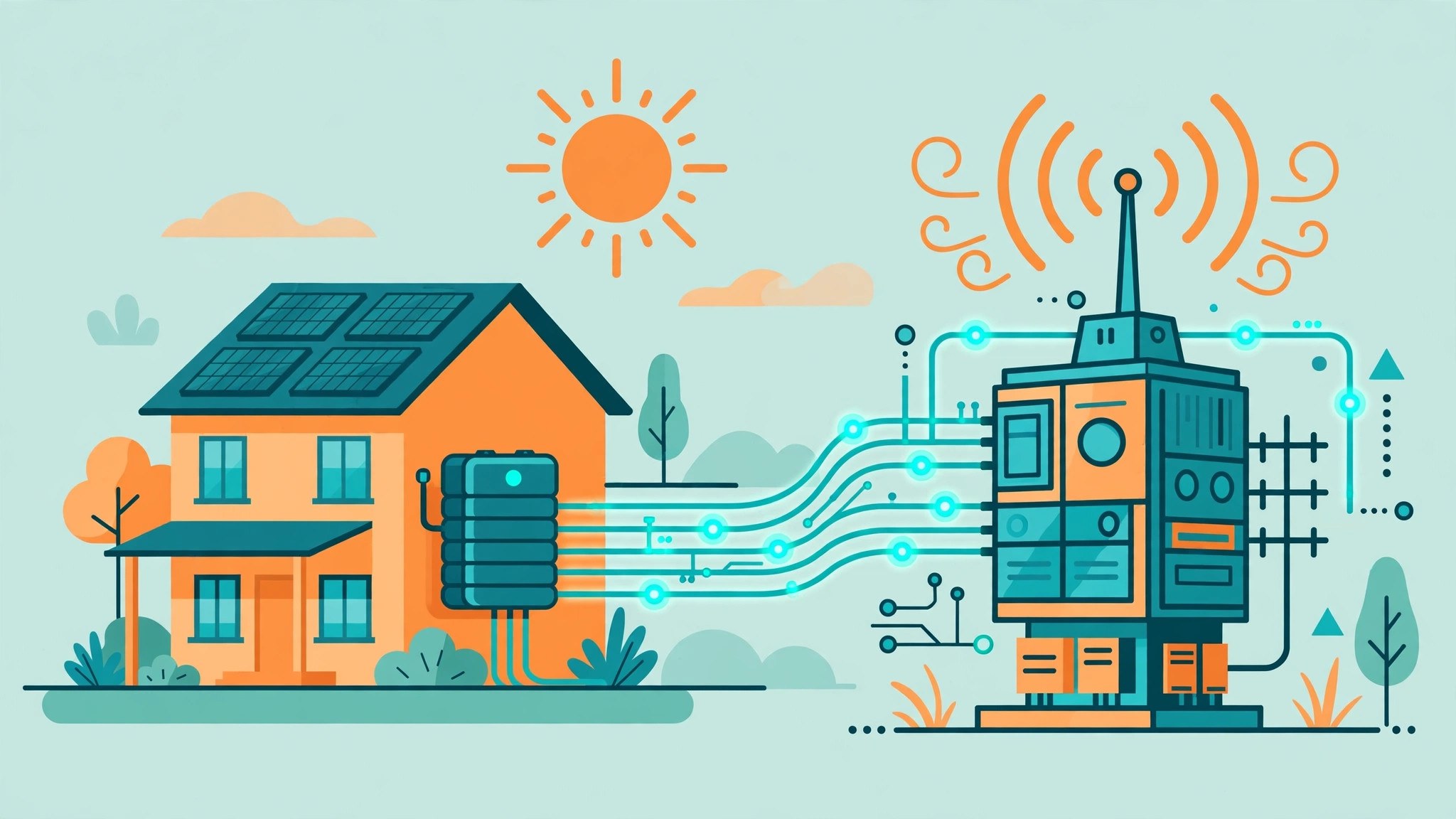
In short: a DERMS is software that lets a utility see, forecast and coordinate thousands of small solar, battery and EV systems as if they were one power plant. For a solar homeowner, that coordination can mean cheaper evening power, smaller demand charges and, in some programs, payment for letting the grid use stored energy.
What DERMS is
DERMS stands for distributed energy resource management system. A distributed energy resource, or DER, is any small energy asset connected to the local grid: rooftop solar, a home battery, an EV charger, a smart thermostat or a heat pump. Our glossary page on DERMS gives the short definition. This guide goes into how the system works and what it means for your bill.
The old grid ran one way. Big power plants sent electricity down wires to homes that only used it. That model is fading. Millions of homes now make power, store it in batteries and charge cars from it, so power flows in both directions on wires built for one. A DERMS is the software layer that keeps that two-way grid stable, turning thousands of small, customer-owned assets into a resource the grid can plan around.
How a DERMS works, in four steps
A DERMS does four jobs, in order, all day long. First, it sees. It collects live data from inverters, batteries, meters and chargers, so the utility knows what is connected and what it is doing right now. Second, it forecasts. It predicts solar output from the weather and demand from past use, so it can spot a problem hours before it happens. Third, it decides which assets to use, where and when, for example charging batteries at midday and discharging them at 6 pm when demand peaks. Fourth, it dispatches, sending control signals that tell a battery to discharge, an EV charger to pause, or an inverter to hold back exports, then checking that the devices did what was asked.
None of this works without common standards. A DERMS has to talk to inverters and batteries from many makers, so it uses open protocols such as IEEE 2030.5 and OpenADR, and smart inverters built to IEEE 1547-2018 can change their output on command. That shared language lets one system coordinate thousands of different devices.
What it does with your solar and battery
Here is the method applied to one home, as an example only, not a quote. Your numbers will differ. Take a home with an 8 kW solar system and a 13.5 kWh battery. On a clear day the panels make about 32 kWh, which is 8 kW times 4 peak sun hours. The home uses about 30 kWh a day: 12 kWh while the sun is up and 18 kWh in the evening. Without any coordination, the 20 kWh of midday surplus goes straight to the grid. At an export rate of 4 cents a kWh that earns 80 cents, while the 18 kWh bought back in the evening at 30 cents a kWh costs $5.40. The net cost for the day is $4.60.
Now add a DERMS-managed battery. The system stores 13 kWh of the midday surplus instead of exporting it, and the battery gives back about 11.7 kWh after 90 percent round trip efficiency. That covers most of the evening use, so the home buys only 6.3 kWh from the grid at 30 cents, which costs $1.89. The 7 kWh still exported earns 28 cents. The net cost for the day is $1.61. The saving is $2.99 a day, about $90 a month and about $1,090 a year. The panels did not change. The timing did.
| Item | Without coordination | With a DERMS-managed battery |
|---|---|---|
| Solar made per day | 32 kWh | 32 kWh |
| Midday surplus exported | 20 kWh | 7 kWh |
| Export credit at 4 cents a kWh | $0.80 | $0.28 |
| Evening power bought at 30 cents a kWh | 18 kWh, $5.40 | 6.3 kWh, $1.89 |
| Net cost per day | $4.60 | $1.61 |
| Saving | None | $2.99 a day, about $1,090 a year |
On a cloudy day the numbers shrink, but the logic holds: the value of your solar depends on when the power is used, not just on how much is made.
Demand charges and grid exports
Demand charges matter most for businesses, and this is where a DERMS earns its keep. A demand charge is billed on the highest 15 or 30 minutes of power use in the month, not on total energy. Take a small business with a demand charge of $15 per kW and a monthly peak of 100 kW. That peak alone costs $1,500 a month. If a DERMS discharges the business battery to cut the peak by 20 kW, the charge falls by $300 a month, which is 20 kW times $15. Shaving the peak saves money even if total energy use barely changes.
Exports need the same care. When a whole street exports solar at noon, the local wires can fill up and voltage can rise. A DERMS can hold back exports on a full circuit, store the surplus in batteries, or send it to another part of the network that needs it. It can also time exports for the evening, when prices are higher. That is why your export rate and battery settings matter more than the size of your array alone. The ScottMadden guide to DERMS explains how utilities use this control to cut losses, manage voltage and defer grid upgrades.
Virtual power plants: getting paid
When a DERMS groups thousands of home batteries and solar systems together, the group can act like a single power plant. That is a virtual power plant, or VPP. During a heatwave or grid emergency, each home's battery discharges a little, and owners are paid per event or per kWh delivered. US rules help here: FERC Order 2222 directs grid operators to let groups of small systems as small as 100 kW sell into wholesale energy, capacity and ancillary markets, so small systems can earn wholesale money.
Joining a VPP does not mean giving up backup power. Most programs keep a reserve in your battery, commonly 20 to 30 percent of its charge, so you still have power in an outage. Before you join, check what you are paid, how often events happen, what reserve is kept, and whether you can opt out of an event. The Virtual Peaker guide to DERMS sets out how enrolment, dispatch and virtual power plants fit together.
What this means for you
You do not buy a DERMS. Your utility or an aggregator runs it, and you join by enrolling a compatible inverter or battery in one of its programs. Enrolment is voluntary in most programs. Before you sign up, ask which devices are compatible, what data is shared, what you are paid, and whether you can override a dispatch signal. An off-grid system never exports, so a DERMS has little to do there.
Compare your options in the free grid-tie vs off-grid comparison tool.
Work out what demand charges cost you
See how much of your bill is demand charges, and what shaving the peak could save.
Open the demand charge reduction estimatorLast updated: 17 November 2026.
Questions
Frequently asked
A DERMS is software that helps a utility see, forecast and coordinate small energy systems such as rooftop solar, home batteries and EV chargers. It treats thousands of separate systems as one flexible resource, so the grid can use stored solar power when demand is high and hold back exports when the local wires are full.
No. Your solar panels and battery work with your inverter whether or not your utility runs a DERMS. A DERMS only comes into play if you join a utility or aggregator program that coordinates your system with the grid, and joining is voluntary in most programs.
A DERMS watches your demand in real time and discharges your battery during the short periods when your demand peaks. For a business, cutting the monthly peak by 20 kW on a $15 per kW demand charge saves $300 a month. The saving comes from the peak, not from total energy use.
In some areas, yes. Virtual power plant programs pay you when your battery discharges during a grid event, and FERC Order 2222 lets groups of small systems as small as 100 kW sell into wholesale markets. Payments vary by program, and your battery usually keeps a reserve of 20 to 30 percent so you still have backup power.