Net metering explained
Net metering decides what every kWh your panels send to the grid is worth. Here is how it works, what it pays, and why the export rate matters more than the panel price.
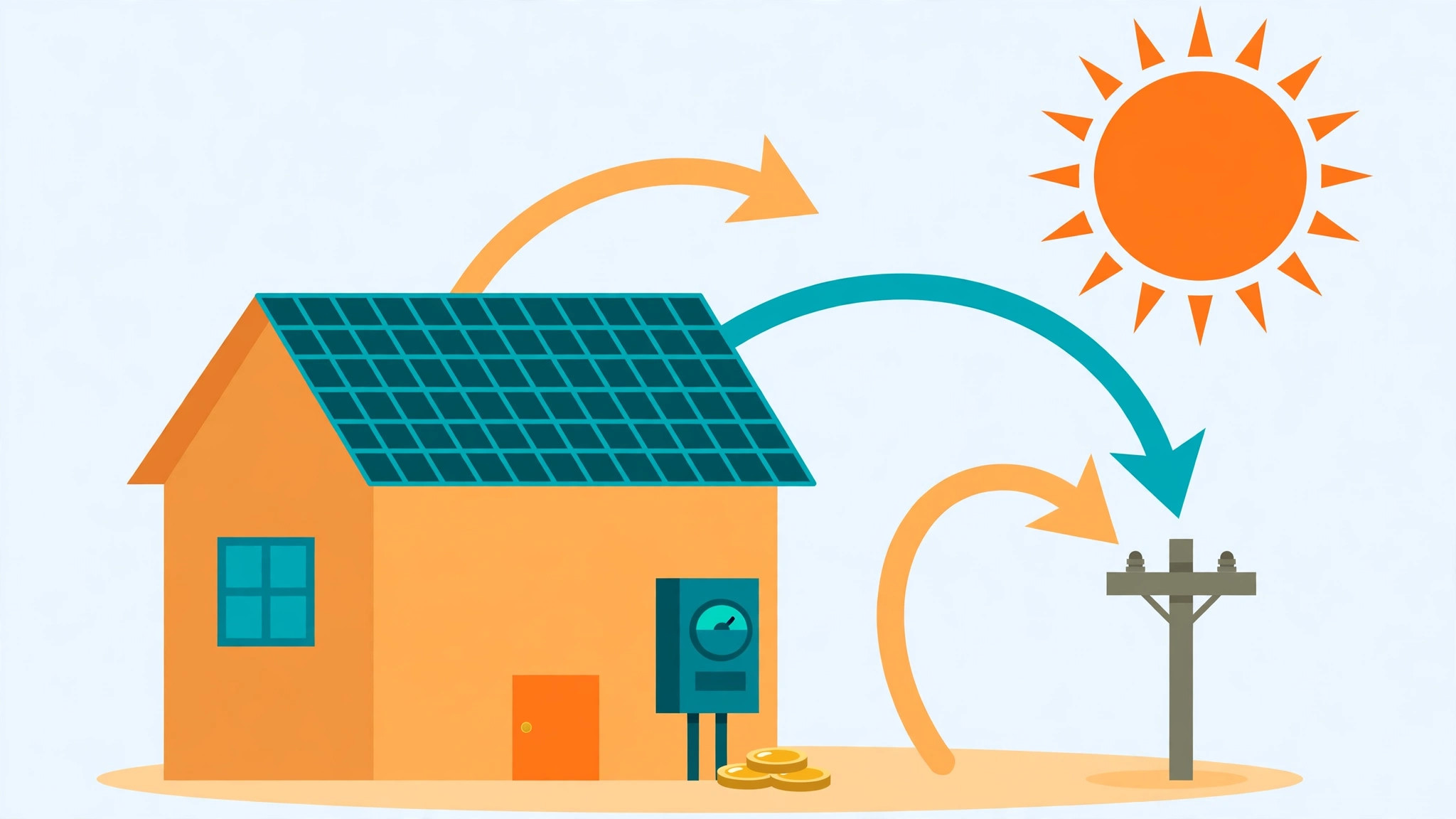
In short: net metering is the rule that decides what your surplus solar power is worth. Under true net metering, every kWh your panels send to the grid earns a credit at the full retail rate, so a 7 kW system cuts a $153 monthly bill to $22.20. Under net billing, the same surplus earns only about 4 cents a kWh, and the same home pays $65.88.
What net metering is
Net metering is a billing rule for homes with solar panels. When your panels make more power than your home uses, the surplus flows out to the grid, and your utility records it as a credit on your account. When your home later draws power from the grid, the credit pays for it. In the classic form of the rule, each exported kWh earns a credit at the full retail rate you pay to buy, so the meter effectively runs backwards.
The rule is common. The US Energy Information Administration counted about 5.5 million net-metered residential solar systems in the United States at the end of 2025. The DSIRE database, kept by the NC Clean Energy Technology Center, maps the rule state by state: its May 2026 map shows net metering in 27 to 28 states plus Washington, DC, and net billing or another rule in 16 states. Your own utility sets the exact terms, so two homes in the same state can be on different rules.
Worked example: a 7 kW system on a $153 bill
Take a home that uses 900 kWh a month and pays 17 cents a kWh. The bill before solar is 900 times 17 cents, which is $153.00 a month. The home installs a 7 kW system in a place with 4 peak sun hours a day. Production is 7 kW times 4 hours times 30 days, which is 840 kWh a month.
The home uses 60 percent of its solar power directly, which is 504 kWh, and sends the other 336 kWh to the grid. The 396 kWh it still needs comes from the grid at night, at 396 times 17 cents, which is $67.32.
Under net metering, the 336 exported kWh earn a credit at the full retail rate: 336 times 17 cents, which is $57.12. The bill is $67.32 minus $57.12, plus a $12 fixed monthly fee, which is $22.20. The monthly saving is $130.80, or $1,569.60 a year.
Now change only the export rate. Under net billing at 4 cents a kWh, the same 336 kWh earn $13.44. The bill is $67.32 minus $13.44, plus the $12 fee, which is $65.88. The saving falls to $87.12 a month, or $1,045.44 a year. The panels, the roof and the sunshine are the same: the export rate alone costs this home $43.68 a month, or $524.16 a year.
| Item | Value |
|---|---|
| Monthly use | 900 kWh |
| Electricity rate | 17 cents/kWh |
| Bill before solar | $153.00 |
| System size | 7 kW |
| Monthly production | 840 kWh |
| Used at home | 504 kWh |
| Exported to grid | 336 kWh |
| Grid power bought | 396 kWh |
| Cost of grid power | $67.32 |
| Export credit at 17 cents | $57.12 |
| Export credit at 4 cents | $13.44 |
| Fixed monthly fee | $12 |
| Bill after solar, net metering | $22.20 |
| Bill after solar, net billing | $65.88 |
| Monthly saving, net metering | $130.80 |
| Monthly saving, net billing | $87.12 |
Tap to compare net metering and net billing
The same 7 kW system and the same $153 bill, with two different export rates. Tap a button to see how the bill moves.
Maths: the home buys 396 kWh at 17 cents, which is $67.32, then subtracts the export credit and adds the $12 fixed fee. Under net metering the credit is 336 kWh at 17 cents, which is $57.12, so the bill is $22.20. Under net billing the credit is 336 kWh at 4 cents, which is $13.44, so the bill is $65.88.
Net metering vs net billing
The two rules differ in one place only: the price of an exported kWh. Net metering pays the retail rate, the same price you pay to buy. Net billing pays a lower export rate, usually the avoided cost rate. In California, the Net Billing Tariff that replaced net metering for new customers in April 2023 pays about 4 cents a kWh on average, against retail rates near 30 to 36 cents: PG&E averages 3.9 cents, Southern California Edison 4.6 cents, and San Diego Gas and Electric 3.7 cents for 2025 and 2026 applicants.
| Export rate | Export credit | Bill after solar | Monthly saving |
|---|---|---|---|
| 17 cents (net metering) | $57.12 | $22.20 | $130.80 |
| 8 cents | $26.88 | $52.44 | $100.56 |
| 4 cents (net billing) | $13.44 | $65.88 | $87.12 |
| 0 cents | $0.00 | $79.32 | $73.68 |
Even at zero cents an export, the home still saves $73.68 a month, because the 504 kWh used at home are worth the full 17 cents each. Self-consumed solar is always worth the retail rate, and only the exported share depends on the export rate, so the more of your own power you use, the less the rule matters.
Where net metering still exists
The map is mixed. The DSIRE May 2026 map shows net metering in 27 to 28 states plus Washington, DC, net billing or another rule in 16 states, and no compensation rule in 1 state. Florida, New Jersey, Maryland and Colorado still credit new residential customers at the full retail rate, while California, Arizona and North Carolina have moved new customers to net billing. Texas has no statewide rule at all, so the export rate there comes from the retail electricity provider, as our Texas guide explains. Older systems are often grandfathered on better terms, so check the rule in force on the day you apply, not the rule a neighbour got five years ago.
Credits, rollover and the annual true-up
Credits do not vanish at the end of each month. Most plans let unused credits roll from month to month, so a sunny June can pay for a dark December. Once a year, usually on the anniversary of connection, the utility settles the account at an annual true-up, paying any surplus left at the avoided cost rate of 3 to 5 cents a kWh, or wiping it out entirely.
That is why oversizing a system is poor value under most rules. Extra panels make power in summer that earns a full credit in June, but a credit still unused at the true-up is settled for pennies. Size the system to your annual use, and check what happens to leftover credits with the rollover calculator below.
How to get the most from your export rate
Use your own power first. Every kWh you use at home is worth the full retail rate, whatever the export rule says, so run the dishwasher, the laundry and the water heater while the sun is up. A battery helps most where the export rate is low, by storing midday surplus for the evening. On full net metering a battery adds little, because the grid already acts as a free battery, so work out the numbers before you add one.
The 30% federal credit is gone
One change affects every state. The 30 percent Residential Clean Energy Credit for homeowner-owned systems ended for property placed in service after 31 December 2025, so a system you buy and own in 2026 gets no federal credit. Leases and power purchase agreements are treated differently, because the solar company can still claim a federal credit on those systems. State, local and utility incentives are separate, so check the DSIRE database by ZIP code.
How to check the rule where you live
Start with the DSIRE database, which lists the net metering and net billing rules by state and utility. Then read your own utility tariff, because the state rule sets the frame and the tariff sets the price. The EnergySage net metering guide explains how the main rules work and what to ask your utility before you sign.
Then run your own numbers with the tools below, using your own bill, rate and export rate, before you sign anything.
Work out how much your own bill would fall with the free monthly bill reduction estimator.
See what happens to your leftover credits
Work out whether your unused solar credits roll over or get paid out at the true-up.
Open the negative bill credit rollover calculatorLast updated: 21 November 2026.
Questions
Frequently asked
Net metering is a billing rule that credits you for the solar power you send to the grid. When your panels make more than your home uses, the surplus flows out, and your utility records it as a credit. When you later draw power from the grid, the credit pays for it, usually at the same retail rate you pay to buy.
No. Even with full net metering, most utilities still charge a fixed monthly connection fee, often $10 to $15, and any power you buy at night is billed at the full rate. In the worked example the bill falls from $153.00 to $22.20, not to zero.
It depends on your utility. Many plans let credits roll from month to month and settle them once a year at an annual true-up, often paying only the avoided cost rate of 3 to 5 cents a kWh for any surplus left. Some plans wipe unused credits out at the true-up, so check your tariff before you oversize a system.
In many states, yes, but not everywhere. The DSIRE map from May 2026 shows net metering offered in 27 to 28 states plus Washington, DC, while 16 states use net billing or another rule. California moved new customers to net billing in April 2023, so check the DSIRE database for the rule your own utility uses.